Né più mai toccherò le sacre sponde
ove il mio corpo fanciulletto giacque,
Zacinto mia, che te specchi nell’onde
del greco mar da cui vergine nacque
Venere, e fea quelle isole feconde
col suo primo sorriso, onde non tacque
le tue limpide nubi e le tue fronde
l’inclito verso di colui che l’acque
cantò fatali, ed il diverso esiglio
per cui bello di fama e di sventura
baciò la sua petrosa Itaca Ulisse.
Tu non altro che il canto avrai del figlio,
o materna mia terra; a noi prescrisse
il fato illacrimata sepoltura.
Ugo Foscolo
A Zacinto
The town of Zakynthos or Chora is the capital of the island and is built in the eastern part of the island, on the foothills of Bohalis. It is a modern town built after the earthquake of 1953, which destroyed most of the island.
The impressive traditional buildings with arches and arched windows and the picturesque squares preserve the traditional style of the old city. Here is situated the main harbor of the island that connects Zakynthos with the mainland through Killini port. Boats to Navagio, Blue Caves, Marathonissi and other beaches of the island also depart daily from here.
Solomos Square, located in the center of the Lombardou Str. (or Strada Marina in Italian) is surrounded by the neoclassical buildings of the National Bank, the Byzantine Museum, the City Hall, the Municipal Library and the Cultural Center, and hosts the statue of our national poet Dionysios Solomos (Source http://www.gozakynthos.gr/gr/zakynthos.town.php).
Bochali, located at the highest point of the city of Zakynthos and only 2 km away, offers a magnificent view of the city, the harbor, Argassi and Laganas bay.
It is one of the oldest neighborhoods of Zakynthos, as it was the first area of expansion of the old capital, which was located in the castle. As acnsequence of the earthquakes, its mansions have collapsed, but it is worth walking in its narrow streets with the old houses.
The hill of Bochali is full of olive and pine trees. Through the main road to Bohali, we reach the central square where there are many food and drink shops, where you can also enjoy the traditional sweet of Zakynthos, Frygania. On the left side of the square one can see the church of Zoodochos Pigi.
Agios Leon (Saint Leon) is a picturesque mountain village located on the west coast of Zakynthos. His name was taken by the bishop of Catania in Sicily who, after being sanctified, became Saint Leon and a church was built in his honor in the 14th century.
The village is also famous for having two scenic rocky coves with turquoise waters, Porto Roxa and Porto Limniona, that can be easily reached by car (source: http://www.e-zakynthos.com/resorts/gr-zante/agios_leon)
The semi-mountainous village of Anafonitria is mainly known for the Monastery of Panagia Anafonitria, in which Saint Agios Dionysios resided in the 16th century, and from which the village took its name. The name of the old village until 1915 was Plemonari. The village is located close to one of the most famous sights of the island, the Shipwreck beach, and from the terrace that is set on its top you can admire the panoramic view.
Vassilikos is a paradise of natural beauty combining green forests with enchanting beaches. It is located 17 km southeast of the town and consists of pine forests, olive groves, vineyards and local farms. Behind its mountains, some of the most beautiful sandy beaches of the island are hidden, such as Saint Nicholas, Banana and Gerakas. Vassilikos is known because many of its coasts are nesting beaches oft he sea turtle Caretta-Caretta turtle (source: http://www.e-zakynthos.com/villages/gr_zante.zakynthos.villages.anafonitria.php).
Volimes village is situated 30 km northwest of Zakynthos town and extends from the pick of the mountain “Vrachion” to the northern coasts of the island. The natural beauty of the landscape with the pine trees, the olive groves and the vineyards which end up in the crystal waters, is enchanting. The sunset in this area is impressive. Do not miss to visit the monastery of St. Andrew and the picturesque chapel of Agios Georgios Gremnon. Volimes is the starting point of exploration of the northern parts of the island including the well known Blue Caves and Shipwreck beach.
On the northwest side of the island one can find the beach of Xygia with warm, thermal waters, Makris Gialos beach, while Agios Nikolaos Volimon is a picturesque harbor that is the only point that connects Zakynthos with the neighboring island of Kefalonia. (source: http://www.gozakynthos.gr/gr/volimes.zakynthos.php)
Kampi is a small mountain village on the west side of the island. In the village there are many findings from the Mycenaean times, such as the funerary monuments at the Mycenaean cemetery, which is accessible to the public.
In the village there are cafes and restaurants with local cuisine and panoramic views of the sea, the spectacular cliffs and the surrounding forests. Numerous visitors come here to admire the enchanting sunset. (source: http://www.e-zakynthos.com/villages/gr_zante.zakynthos.villages.kambi.php).
Within a distance of about 20 km from the town of Zakynthos lies Keri Lake, which is extended along the edge of Cape Marathia.
It is characterized by a beautiful pebble beach, shaded by a few pines and is surrounded by many local taverns, which, create a very special atmosphere, especially in the evening.
Keri Lake is an ideal starting point to visit the caves and the beaches of Keri. At the crossroad before Keri Lake, you can take the ascending road to your right hand and, in a few minutes, you reach the mountainous village of Keri.
This small and enchanting village, with its narrow streets, old houses and the café of the central square, gives you the image of the simple life of a place where time seems to have stopped.
In Keri you should not miss the opportunity to climb up to the lighthouse, especially at sunset, from where you can admire the impressive rocks of Mytzithres in all their grandeur.
(Source: https://www.zanteisland.com/el/limni-keri-zakynthos.php).
Kiliomeno (also known as Agios Nikolaos) is a mountain village in central Zakynthos with approximately 350 permanent residents, who are mainly engaged in agriculture and livestock farming. It is 16 km from the city of Zakynthos.
The name Agios Nikolaos comes from the old church in the village. Its bell tower was built in 1893 by local stone craftsmen, who made the village famous in Zakynthos due to its stone houses, a typical example of the traditional architecture of the island.
In the village operates the Women’s Agricultural Cooperative of Melissios Melissios, founded in 2007 and deals with the production of traditional products (spoon sweets, pastries), oil, wine, cheese, honey, aromatic plants.
The village of Litakia, which houses the Casa di Pierro, is one of the oldest villages on the island and is the extension of Laganas Bay. Lithakia is not a very tourist village and thus maintains its traditional character and its natural beauty.
The village is located between the areas of Keri Lake and Laganas on the southeast side of the island. The church of Agios Ioannis located in the village is a sample of traditional Zakynthian architecture. The village is also home to the traditional open-air mill and landscapes with perennial olives.
The village also hosts the picturesque harbor of Agios Sostis with the islet of Cameo and Porto Koukla beach, opposite Marathonisi.
After Katastari, Macherado is the second largest village in the plain. Place fertile with raisin crops. In Macherado you can visit the restored 14th-century Ypapanti church with a bell tower from the highest of Zakynthos. The main attraction is the church of Agia Mavra. It is a one-aisled basilica with exceptionally rich decoration.
Agios Sostis

Agios Nikolaos-Volimes

Vasilikos

Gerakas

Dafni

Xigia

Korakonisi

Makris Gialos

Marathias

Marathonissi

Mizithres

Shipwreck

Porto Limnionas

The presence of Zakynthos is marked already in prehistoric times. The first reference to the island is made by Homer in the Odyssey, where he calls it “Ylisessa”, that is, woodland. According to the ancient geographer Pausanias, the island was named after Zakynthos, the son of the king of Phrygia Dardanos, who first settled the island, giving it his name around 1500 BC.
The 2nd century BC finds Zakynthos under Roman occupation and then under Byzantine domination.
At the beginning of the 2nd millennium AD, as the Byzantine empire is heading towards its fall, the Crusaders make their appearance.
In the late 12th century AD , the Franks occupy the Ionian islands and establish in 1185 the Palatinate County of Kefallinia-Zakynthos, which will last for three centuries under the leadership of the Orsini family initially, the Anguillai later and eventually the Tokes. In 1479 the Ottomans occupy Zakynthos.
The Venetians, recognizing the strategic importance of Zakynthos, occupy the island in 1485.
Venetian occupation gives to the island for the first time in centuries, the possibility of economic and intellectual blossoming. The inhabitants were divided into three classes: the nobili, the civili, and the popolari. Only the class of the nobles, whose names were written in the Libro d ‘oro (Golden Book), had political rights.
The brutal exploitation of the people by the nobles led to the rebellion of the lower class of Popolari, the first social revolution in the history of modern Greece (1628-1632), which was eventually violently suppressed. The Zakynthians enthusiastically welcomed the messages of the French Revolution of 1789.
Venetian domination ends after three centuries, in the last years of the 18th century, with its demise by the French Democrats.
On July 4, 1797, the three-color democratic flag replaces the flag of St. Marco in Zakynthos, and the Zakynthians enthusiastically welcome the ideas of freedom, equality and brotherhood. A few days later and with enthusiastic celebrations, the Libro d ‘oro is burned in San Marco Square.
The French occupation lasts only 15 months. In October 1798, the Russians and Turks occupy the Ionian islands, an occupation which lasted almost two years. Finally, in 1800, the two forces decided to establish an independent state under the name “Ionian State”.
The Ionian State, which was the first independent Greek state of modern history, lasted seven years. In 1807 , the French imperial troops occupy the Ionian islands. Two years later, in 1809, the English fleet occupies Zakynthos.
The British occupation (1809-1864) was the last period of occupation before the union with Greece. Major infrastructure projects took place during this period, such as roads, bridges, and a part of the harbor.
Following the liberation from the Ottomans and the establishment of the Greek state, the request of the union of the Ionian islands with the rest of Greece is persistent. England, along with France and Russia, signed on June 5, 1863 in London, a treaty according to which, England should no longer act as the protector of the Ionian islands.
On 21 May 1864, the union of the Ionian islands with Greece was formalized.
In the 20th century, in 1953, a devastating earthquake followed by an extended fire destroys the island of Zakynthos. Historical buildings and churches are thus lost along with the treasures they contain. The city is rebuilt, this time according to a very strict seismic rule, while trying to maintain its old character.
The architecture of Zakynthos, with influences by the Venetians, the French and the English, contains plenty of Western European elements. The current architecture of the island, however, was formed after the devastating earthquake of 1953, where the city and its villages were rebuilt as most of the island was flattened. Some remarkable monuments, still retain their original architecture, with the main feature of the arches.
The churches of Zakynthos are built as three -aisled basilicas and are accompanied by large bell towers. The church of Agios Dionysios, Agios Nikolaos of Molos and the Lady of the Angels, bring together the main architectural interest.
This museum is located on Dionysios Solomos Square and opened its doors to the public for the first time in 1960. It extends on three floors and the first two rooms immediately give the visitor the opportunity to admire wood-carved icons of the Byzantine era, while in the third and fourth floor, one can find the original frescoes of the 15th, 16th and 17th centuries.
Two more halls are dedicated to the 18th century painting tradition and contain oil paintings by artists such as Doxoras, Koutouzis and Kantouni.
The visitor can also see the pictures and representations of the city before the earthquake, as well as learn about the artistic evolution from the post-Byzantine period to the present day.
The museum is open daily except Monday from 8:30 to 15:00.

This museum, founded in 1959, is located in the impressive small square of Saint Marco and is well-known because it ist he ossuary of Dionysios Solomos and Andrea Kalvos, the famous poets of Zakynthos.
Inside the building there are also paintings of the 18th and 19th centuries, ceramics, sculptures and ancient musical instruments. Of particular interest is the apparel and arms department of the aristocratic families of the island.
The museum also hosts portraits of iconic personalities of the island and a collection of coats of arms.
The museum is open daily from 9:00 to 14:00.

The municipal library is located at Solomos Square, in the building that houses the cultural center of Zakynthos.
Its history began in 1628 and, prior to the earthquake and catastrophic fire of 1953, it kept unique books and manuscripts.
Thanks to the donations of certain Zakynthians, the municipal library regained some of its old archive and made available to the public its new acquisitions.
In the library, it is possible to find rare books about the history and traditions of Zakynthos, copies of old newspapers and memoirs, and photographs of Zakynthos before the 1953 earthquake.

The Caretta Caretta Thematic Exhibition Center is located in Dafni area within the protected National Marine Park of Zakynthos.
The exhibition and informative material as well as the Center’s actions aim at informing and raising awareness about the protection of the sea turtle Caretta caretta, as well as the information on other endemic species of flora and fauna in Zakynthos.
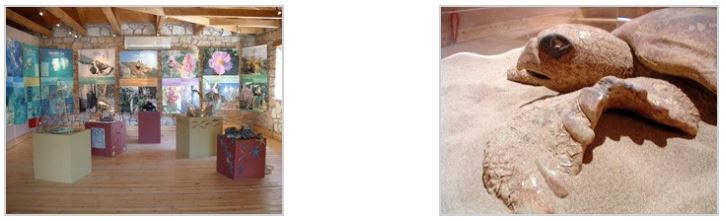
The Helmes Natural History Museum was founded on 10 October 2000 and is located in the village of Agia Marina.
The collection of the museum includes samples of flora and fauna of Zakynthos such as rocks, fossils of plants and animals, shells, fish and birds. For more information on opening hours, please visit the website: www.museumhelmis.gr.

The Naval museum is located in the area of Tsilivi and contains exhibits that bear witness to the nautical history of the island from the 17th century until today.
The collection contains paintings of watercolors describing the evolution of sea transport as well as a large variety of models of ships from the period of the Byzantine Empire.
The museum is open from 8:00 in the morning until 15:00 upon appointment only.

It was founded in 1998 in the small village of Pigadakia and its exhibits are related to the rural tradition in Greece and especially on the island.
In its interiors, you can admire rare objects from the 16th century, such as professional tools, everyday utensils, and rare works of local craftsmanship.
The museum is a rebuilding of a traditional home with a living room, a kitchen and a bedroom with traditional furniture.
In its exteriors, there are also agricultural machines used by the Zakynthians for wheat as well as for the pressing of the grapes.

The home of the internationally renowned poet Ugo Foscolo, who was born in Zakynthos in 1778, is the only reference to the great Italian poet on the island. The house was completely destroyed in 1953 by the earthquake and remained a plot for more than 60 years.
In 2009, the Zakynthos Cultural Association “Ugo Foscolo” was founded, dedicated to raising the importance of the poet’s work. At the initiative of the Association, in collaboration with the Municipality and the Region of Ionian Islands, the home of Foscolo was built in its original form, that is, from the middle of the 18th century, in Odigitria neighborhood in the center of Zakynthos.
The Stone Park Askos is located at the northern edge of the island, in the area of Volimes. The park is home to about 200,000 native plants and trees, as well as hundreds of animals that live freely in their natural habitats, such as wild hawks, mammals, various species of native birds, amphibians and insects.
For information about the opening hours, visit the park website, https://www.zanteweb.gr/zakynthos.zante/gr/askos-park
In the nearby village of Lithakia, just three kilometers from the property, you can find the traditional Aristaion olive press, which also houses the museum of olives and olive oil.
At the olive press, whose journey begins in 1850, visitors are guided to the oldest and newest olive oil production technologies and have the opportunity to try local products based on organic olive oil.
Opening hours: Monday – Sunday – 09:00 – 19:00
The main celebrations of the island are:
Festivals and concerts: The island offers numerous events and festivals especially during the summer months. For more detailed information, visit https://www.zakynthosevents.com/
The island offers a variety of alternative activities such as:
Zakynthos has many paths where guests can admire the nature of the island and its picturesque villages.
For more information on hiking trails, visit http://www.topoguide.gr/hiking_on_zakynthos.php
In the area of Kalamaki, in the bay of Laganas, activities for advanced and beginner horsemen are offered.
In the bay of Laganas, just a hundred meters from the property, you can rent boats and sea bikes, and enjoy the rare natural beauty of Marathonissi, the sea turtle Caretta-Caretta, and the caves of Keri.
Zakynthos has a rich gastronomic tradition.
Typical local dishes include the Zakynthian rabbit, the spicy Ladotyri (“Oil-cheese”), tthe “Zakynthian prositto”, the thick egg-lemon soup, the aubergines with garlic sauce “scordostoumpi”, the hand-made pastels, mandolato and pastel, as well as wine varieties found only on the island, such as Avgoustiatis.
Materials:
12 cups of boiled turkey broth
6 tablespoons of rice
2 egg yolks
2 egg whites
juice of 2 lemons
salt
freshly ground black pepper
½ cup of Zakynthian ladotyri
Implementation:
Put the broth in the fire until it boils.
Add the rice and let it boil for 15-20 minutes.
In a bowl, whisk the egg whites until they coagulate, and in another bowl wisk the yolks.
Slowly pour the lemon juice on the yolks by stirring continuously. Stir the mixture and then pour the egg whites slowly.
Add two cups of broth again slowly, stirring in one direction.
Pour the mixture into the broth with the rice and add salt and pepper.
Serve with grated cheese.
For local and long-distance services, visit the website of the Bus Enterprise of Zakynthos at the following link:
https://ktel-zakynthos.gr/gr/routes/summer-local-schedules/tsilivi-zakynthos
Police Station of Zakynthos: 26950 42550, 26950 22100
Direct Police Action: 100
Laganas police station: 26950 51251, 26950 52022
Police Station of Volimes: 26950 31204
Police Station of Catastari: 26950 83217, 26950 83083
Tourist police: 26950 27367, 171
Municipal Police: 26950 42064
Hospital: 26953 60500
EKAB (National First Aid Centre): 26950 23166, 166
Port Authority of Zakynthos: 26950 28117, 26950 28118
Port Authority of Killini: 26230 92211
Ionian Group Ferries: 26950 25400
Fire Brigades: 26950 22199, 26950 22161, 199
Forest Office: 26950 41125
Direct Coast Guard intervention: 108
Forest Fires Intervention: 191
Post Office: 26950 42476, 26950 44875
Airport: 26950 29500
Bus Enterprise: 26950 42656, 26950 22255
Radio Taxi: 26950 48400
Poison Center: 210 7793777
Alphabank: 26950 22336
National Bank: 26950 21001
Eurobank: 26950 23172
Piraeus Bank: 26950 24066
Casa di Pierro Zakynthos
Lithakia, Zakynthos
29092, Greece
Tel: +30 2695053060
Mob: +30 6976512505
casadipierro2018@gmail.com
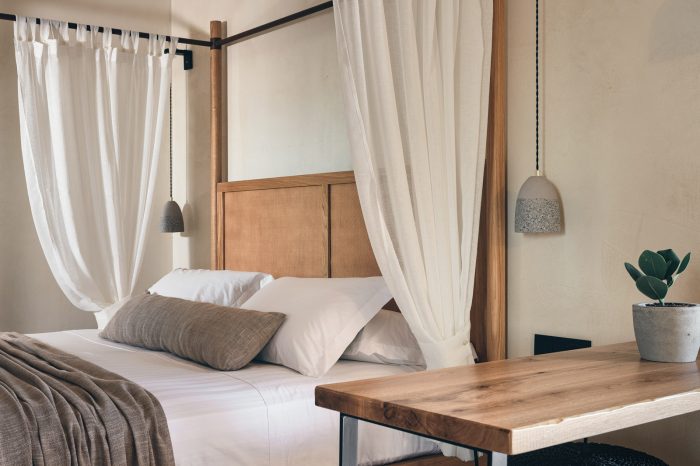
The hotel offers six luxurious suites with modern amenities, spacious private balconies, while offering a unique view of olive groves as well as sea view from the first level.